Cerebral Palsy
Comprehensive Cerebral Palsy Rehabilitation: Helping Every Child Reach Their Potential
COMPREHENSIVE CEREBRAL PALSY REHABILITATION
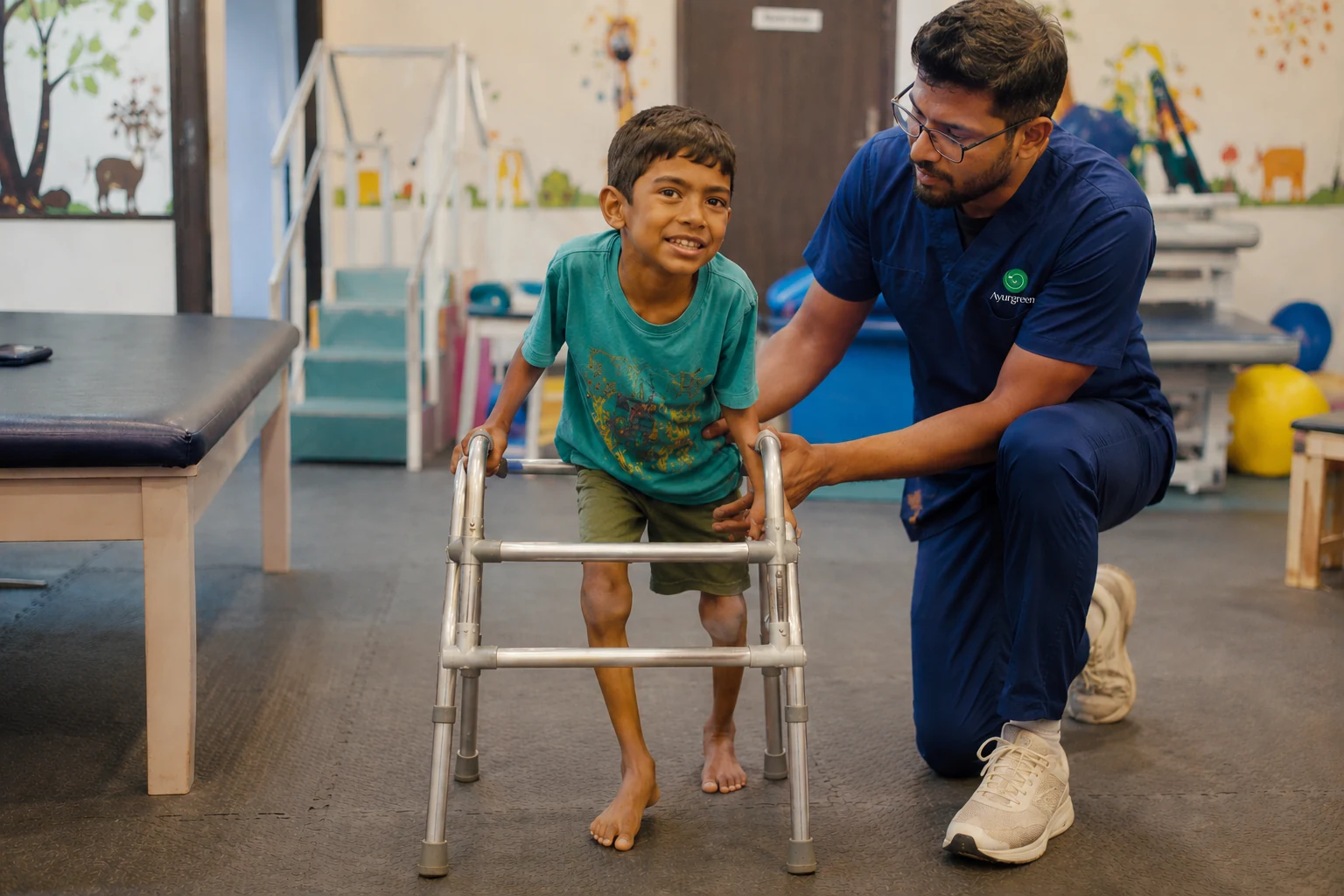
Cerebral Palsy (CP) is the most common physical disability affecting children and is caused by injury or abnormal development of the developing brain before, during, or shortly after birth. Although the brain injury itself is non-progressive, the effects on movement, posture, muscle tone, communication, feeding, learning, and daily functioning can significantly impact a child's quality of life. Early identification and timely intervention play a crucial role in maximizing a child's developmental potential and preventing secondary complications.
Children with Cerebral Palsy commonly present with muscle stiffness (spasticity), abnormal posture, delayed motor milestones, difficulty walking, poor balance and coordination, speech and language difficulties, swallowing problems, feeding challenges, joint deformities, and learning difficulties. The severity varies widely, ranging from mild functional limitations to significant physical dependence requiring lifelong support.
At Ayurgreen Hospital, we believe that successful Cerebral Palsy management requires a comprehensive multidisciplinary approach. Because CP affects multiple body systems, treatment cannot be provided by a single specialist alone. Our team includes neurologists, paediatricians, orthopaedic surgeons, Physical Medicine and Rehabilitation (PM&R) specialists, physiotherapists, occupational therapists, speech and language therapists, orthotists, psychologists, nutritionists, respiratory therapists, and Ayurvedic physicians working together to create individualized rehabilitation programs.
Spasticity is one of the most common challenges faced by children with Cerebral Palsy. Due to damage to the upper motor neuron pathways, muscles become abnormally tight and stiff, restricting movement and causing difficulty with sitting, standing, walking, dressing, and self-care activities. If left untreated, persistent spasticity may lead to muscle contractures, joint deformities, hip dislocation, scoliosis, foot deformities, pain, and loss of functional abilities.
Management of spasticity begins with comprehensive neurological and rehabilitation assessment. Treatment may include stretching programs, positioning techniques, splinting, orthotic management, serial casting, oral medications such as Baclofen, Tizanidine, Diazepam, or Dantrolene, and Botulinum Toxin injections for focal muscle overactivity. In selected severe cases, advanced interventions such as Intrathecal Baclofen Therapy or neurosurgical procedures may be considered.
Who Can Benefit?
Specialized clinical evaluation and evidence-based rehabilitation protocols tailored to each patient.
Spastic Cerebral Palsy (Hemi, Di, Quad)
The most common type — characterized by muscle stiffness and spasticity. Hemiplegic (one side), diplegic (both legs), and quadriplegic (all four limbs) spastic CP each have specific rehabilitation approaches using robotic systems, Botox, and Ayurvedic spasticity management.
Dyskinetic & Athetoid CP
Characterized by involuntary, uncontrolled movements. Our program uses sensory integration therapy, specialized physiotherapy, and Ayurvedic calming therapies to improve movement control and reduce involuntary movements.
Ataxic & Mixed Cerebral Palsy
Ataxic CP with poor balance and coordination is addressed through intensive balance training and the Huber 360 platform. Mixed CP types are comprehensively managed with customized programs targeting each component of the child's presentation.
Specialized Rehabilitation Services
Individualised therapeutic interventions combining advanced technology with clinical expertise.
Robotic & Technology-Assisted Therapy
Our robotic systems are adapted for pediatric use: the Armotion provides guided arm therapy for hemiplegic CP; the G-EO system provides supported walking practice for children who cannot yet walk independently; and the Huber 360 provides balance and core strengthening for ataxic and diplegic CP. These systems deliver the volume and precision of movement training critical for pediatric neuroplasticity.
NDT, CIMT & Intensive Physiotherapy
Neurodevelopmental Therapy (NDT/Bobath) is the foundation of our physiotherapy program for CP, addressing tone, posture, and functional movement patterns. Constraint-Induced Movement Therapy (CIMT) and Hand-Arm Bimanual Intensive Therapy (HABIT) maximize arm function in hemiplegic CP. Intensive physiotherapy for gait retraining, balance, and muscle strengthening.
Ayurvedic Therapies for Cerebral Palsy
Kerala Ayurveda has a rich tradition of therapies for developmental movement disorders. Abhyanga (oil massage) with specific medicated oils reduces spasticity and promotes sensorimotor development; Njavara Kizhi strengthens weak muscles; Shirodhara calms the nervous system in dyskinetic CP; and Medhya Rasayana formulations (Brahmi, Shatavari) support cognitive development and neuroprotection.
Speech Therapy & Occupational Therapy
Comprehensive speech therapy for CP-related communication disorders (dysarthria, AAC), feeding difficulties, and language delay. Occupational therapy for fine motor development, sensory integration, adaptive equipment prescription, school participation, and independence in all ADLs — helping each child achieve their maximum educational and social participation.
Advanced Rehabilitation Technologies
State-of-the-art robotic systems and specialized clinical equipment accelerating motor recovery.
Pediatric Robotic Gait Training
G-EO and supported walking systems adapted for children, providing body-weight support and guided gait training to promote walking development in non-ambulant CP children.
Armotion Upper Limb Therapy
Robotic guided arm therapy for hemiplegic CP children, combined with CIMT to maximize use and development of the affected arm.
Huber 360 Balance Training
Dynamic balance, coordination, and core strength training for ataxic and diplegic CP — improving postural stability and walking ability through interactive programs.
Ayurvedic Neurodevelopment
Traditional Kerala Ayurvedic therapies (Abhyanga, Njavara Kizhi, Brahmi Rasayana) specifically adapted for children to reduce spasticity, strengthen muscles, and support healthy neurodevelopment.
Botox for Spasticity
Targeted botulinum toxin injections to reduce focal spasticity (calf, hamstring, hip adductors) — creating a window for intensive physiotherapy to maximize functional gains in spastic CP.
Your Recovery Journey
Our recovery path is a carefully structured, multi-phase clinical progression that guides patients smoothly from intake to dynamic independence.
1. Assessment
Comprehensive medical assessment by our multi-disciplinary panel.
2. Diagnosis
Pinpointing motor, sensory, and biological imbalance vectors.
3. Personalized Plan
Scheduling custom robotic runs and targeted Ayurvedic protocols.
4. Therapy
Intensive, daily physical training and cellular purification treatments.
5. Monitoring
Strict weekly tracking of physical and sensory progress data.
6. Recovery
Achieving optimal independence and preparing a home transition plan.
Frequently Asked Questions
Clear, evidence-grounded answers to help patients and families understand care pathways and recovery expectations.
Our programs are tailored for individuals experiencing Spastic Cerebral Palsy (Hemi, Di, Quad), Dyskinetic & Athetoid CP, Ataxic & Mixed Cerebral Palsy. Every patient undergoes a multidisciplinary clinical assessment to determine the most effective, individualized care pathway.
The program integrates Robotic & Technology-Assisted Therapy, NDT, CIMT & Intensive Physiotherapy, Ayurvedic Therapies for Cerebral Palsy, combining evidence-based clinical protocols with targeted rehabilitation and supportive care to achieve maximum functional recovery.
We bring together 25+ years of clinical excellence, blending state-of-the-art robotic and physical therapy with authentic Ayurvedic treatments (such as Panchakarma, specialized herbal therapies, and metabolic correction) under strict medical supervision.
We utilize standardized clinical outcome measures, computerized biofeedback assessments, and periodic multidisciplinary team reviews to objectively measure functional gains, strength, balance, and independence.
Start Your Recovery Journey Today
Consult with our integrated clinical panel and Ayurvedic scholars to design a fully personalised pathway to recovery.